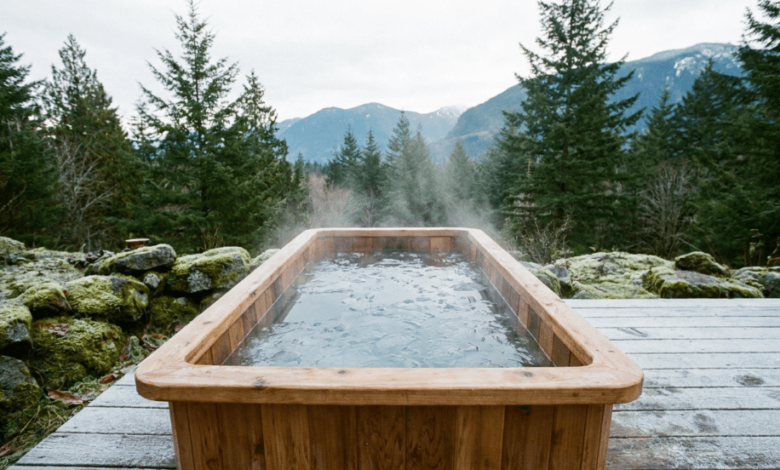
For a small backyard, patio, or garage corner, the choice usually comes down to two approaches: a traditional manual tub filled with ice and hose water, or a compact plunge paired with an infrared panel for a warm-up phase in the same footprint. A manual tub costs less upfront and needs no electrical circuit, while a paired setup with a chiller and infrared panel holds a consistent temperature and uses the square footage twice, once cold and once warm
What counts as a “traditional” cold plunge?
A traditional setup is about as simple as cold exposure gets: an insulated stock tank or rotomolded tub, filled with tap water and brought down with bagged or block ice. There is no compressor, no refrigerant line, and nothing to plug in unless you add a filter pump. For someone testing the habit before committing real money, this is the lowest-risk entry point. The tradeoff is temperature drift. A 100-gallon tub cooled with ice will sit in the high 30s to low 40s Fahrenheit right after filling, then climb several degrees within an hour, faster in warm weather or direct sun. Anyone plunging daily needs to either restock ice constantly or accept a less precise session.
How does a paired-infrared setup change the footprint math?
A paired setup puts a small chiller-cooled tub next to, or facing, a compact infrared panel, so contrast therapy happens without walking across the yard. The plunge side typically runs 45 to 90 gallons for a one-person tub, small enough for a 3-by-3-foot pad, and the panel itself mounts to a wall or stands on a narrow frame that adds only a foot or two of depth. Because both pieces sit in the same corner, this configuration often uses less total space than a full cedar cabin sauna plus a separate plunge tub scattered elsewhere in the yard. It does require a dedicated circuit for the chiller, usually 15 to 20 amps, and GFCI protection near standing water, which a licensed electrician should confirm against local code.
How much drainage and site prep does each option need?
A manual tub needs the least site work: a level patch of gravel, pavers, or an existing deck section, plus somewhere nearby to dump used water when you change it, whether that is a garden bed, a floor drain, or a hose run to a low spot in the yard. A paired chiller setup adds a bit more complexity, since the compressor housing needs airflow clearance on at least one side and a dry, level pad of its own next to the tub. Neither option requires plumbing into the house’s drain system, which keeps both approaches realistic for a rental or a yard where permanent plumbing changes are not an option.


What does upkeep look like for each option?
A manual, ice-filled tub needs a cartridge or sand filter at minimum to keep the water usable between fills, and most owners still drain and scrub it weekly to control algae and bather waste. A chiller-based unit usually pairs an ozone generator or UV sterilizer with a filtration loop, which stretches water changes out to several weeks instead of days, at the cost of a compressor that needs occasional servicing. Neither option is maintenance-free, but the manual route trades money for labor, and the chiller route trades labor for equipment cost.
Which setup actually fits a small space better?
If square footage is the binding constraint, a compact chiller-and-panel pairing usually wins because it consolidates the cold and warm phases into one corner instead of two separate zones. If budget is the binding constraint and the space is only slightly tight, a traditional ice tub on a 4-by-4-foot deck section or gravel pad is a reasonable starting point, with the option to add a chiller later. Several current tubs and panels are sized specifically for exactly this kind of small-footprint pairing, and a specialty retailer that stocks both categories side by side makes it easier to view current pricing across sizes before settling on dimensions for a tight corner.
What does each option cost to get started?
A traditional manual tub is the cheaper entry point. A quality insulated stock tank or rotomolded shell runs somewhere in the low hundreds to around a thousand dollars depending on size, and bagged ice is the only recurring cost beyond that. A paired chiller-and-panel setup costs considerably more upfront, since the chiller unit alone often runs into the low thousands before the tub or panel is even factored in, plus the electrician’s fee for the dedicated circuit. The gap narrows over time for anyone plunging often, since ice for daily use adds up faster than most people expect, but for occasional use once or twice a week, the traditional route usually stays the cheaper choice for a full season.
What does the research say about cold-water immersion itself?
Regardless of which equipment path you pick, the physiological picture is genuinely mixed. A 2025 systematic review and meta-analysis in PLoS One found cold-water immersion associated with short-term improvements in mood and modest reductions in inflammatory markers, without strong evidence for larger long-term effects. A Cochrane review of cryotherapy after exercise found a small, inconsistent reduction in delayed-onset muscle soreness compared with rest, and a Frontiers in Physiology meta-analysis on post-exercise cold-water immersion reported benefits for perceived fatigue that did not always translate into measurable performance gains. None of this makes cold plunging pointless, but it argues against treating either setup as a guaranteed recovery upgrade.
Frequently Asked Questions
Do I need a chiller for a cold plunge, or can I just use ice?
Ice alone can get a small tub into the high 30s to low 40s Fahrenheit, but the water warms back up within an hour or two in most climates. A chiller holds a set temperature automatically and is the better choice if you plan to plunge several times a week.
How much space does a compact cold plunge actually need?
A single-person tub with a chiller typically needs a footprint close to 3 by 3 feet, plus another foot or two of clearance for the compressor unit and any drainage. Paired setups with an infrared panel need roughly double that.
Is a traditional ice-and-tub setup cheaper than a chiller unit?
Upfront cost is lower with a manual tub and bagged ice, but the ongoing ice cost adds up fast for anyone plunging more than once or twice a week, which is where a chiller usually pays for itself within a year or two.
Can cold plunging and an infrared panel share the same small footprint?
Yes. Many small-space contrast setups place a compact infrared panel next to or facing a plunge tub so the same corner of a garage, patio, or basement handles both the cold and the warm-up phase.
What temperature range should a small-space cold plunge target?
Most home setups run between 39 and 55 degrees Fahrenheit. Beginners generally start closer to 55 and work down toward the low 40s as tolerance builds, rather than starting at the coldest setting.
References
- Effects of cold-water immersion on health and wellbeing: A systematic review and meta-analysis, PLoS One, 2025. https://pubmed.ncbi.nlm.nih.gov/39879231/
- Cold-water immersion (cryotherapy) for preventing and treating muscle soreness after exercise, Cochrane Database of Systematic Reviews, 2012. https://pubmed.ncbi.nlm.nih.gov/22336838/
- Effects of cold water immersion after exercise on fatigue recovery and exercise performance: meta analysis, Frontiers in Physiology, 2023. https://pubmed.ncbi.nlm.nih.gov/36744038/
By Megan Torres